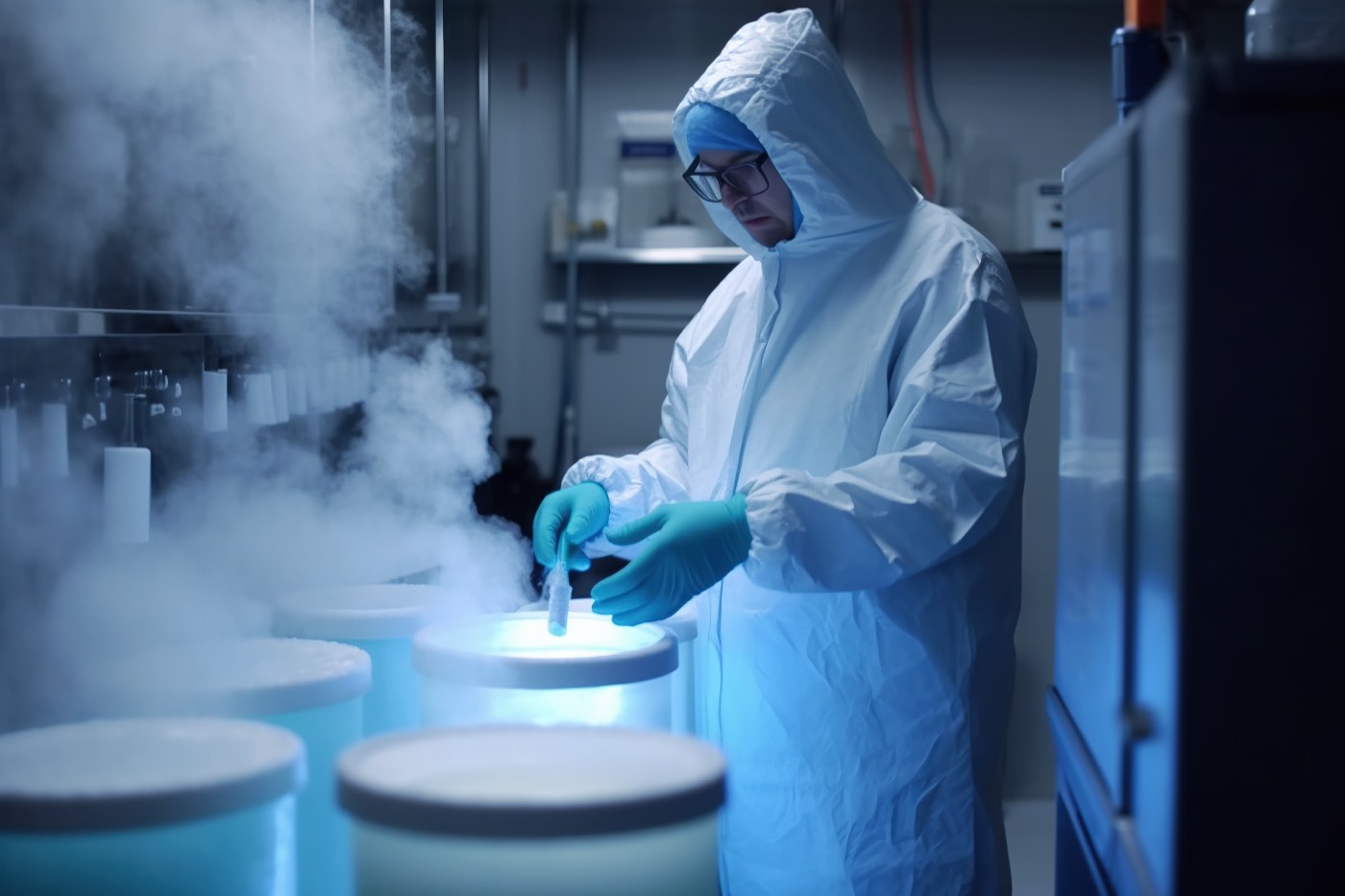
Fig. 01 / Sector BSample withdrawal from a vapor-phase dewar during a scheduled integrity audit. Patient-frame clocks in this vault have not advanced since 2019.Cryosek Laboratories
Cryosek Laboratories · Metabolic Stasis Division
You'll wake up in a cryosec.
Between the last second before the hold and the first second after it, the
nervous system records one unit of elapsed experience. One cryosec.
A century of objective time. A second of yours.
1. metrology
The unit of subjective elapsed time across a stasis interval.
By definition, 1 cs ≡ 1 s of perceived duration, irrespective of the
objective span of the hold.
2. clinical
The interval a patient reports between induction and reanimation.
Universally reported as instantaneous; never yet measured above 1.000 cs.
3. colloquial
“Give me a cryosec.” — an indeterminate objective wait costing the
waiting party nothing at all.
Origin: coined at Cryosek Labs, 2019, from cryo- (κρύος, frost)
+ sec (secundum). Adopted in internal protocol CSK-114 as the standard
unit of patient-frame duration.
Amorphous phase · no crystal front
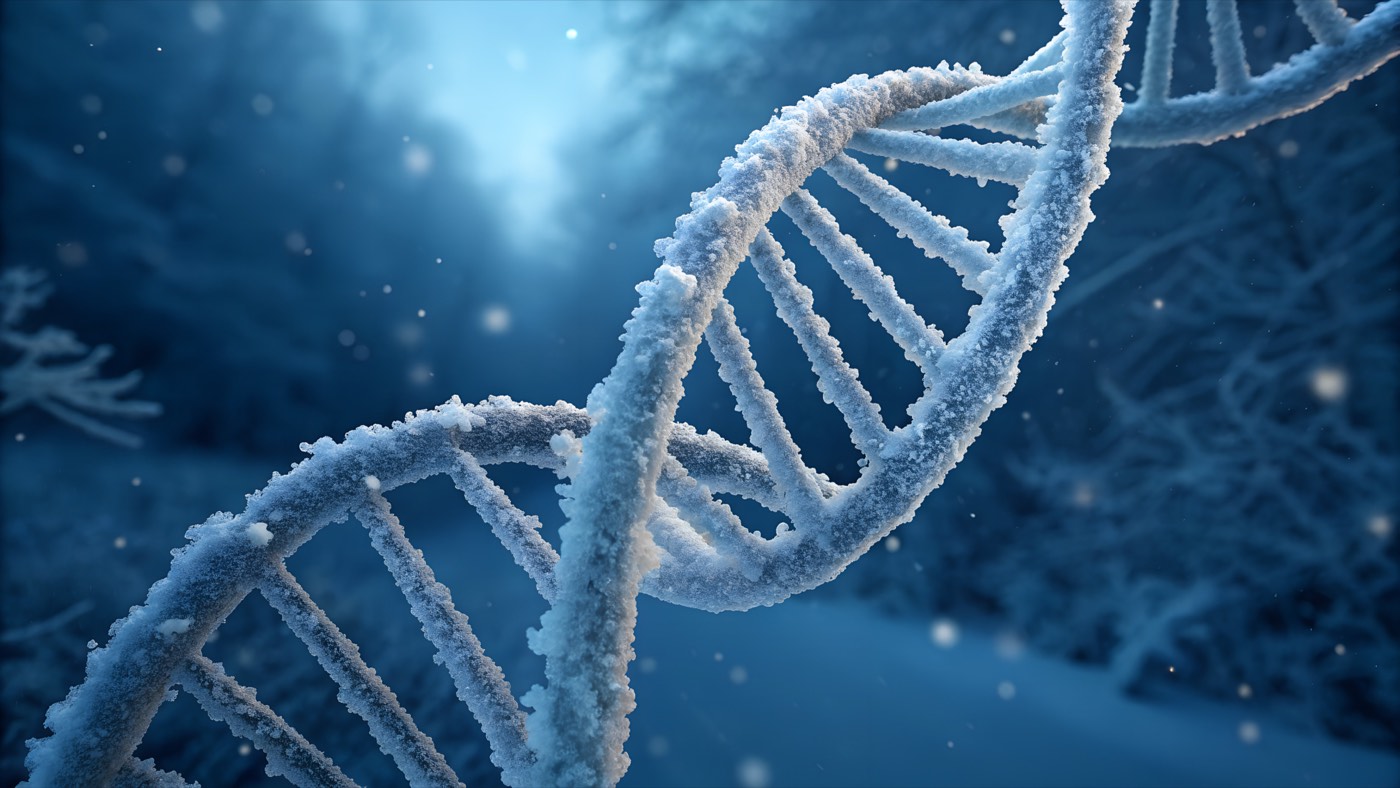
Fig. 02 / Cryo-SEMVitrified nucleic-acid structure below Tg. The surface is glass, not ice — the distinction the entire protocol exists to preserve.Protocol CSK-114
02 The Science
Not freezing. Vitrification.
Ice is the enemy — not cold. Crystal formation shears membranes and severs
the connectome. Cryosek's protocol removes the water phase transition
entirely: tissue is carried into an amorphous glass state in which molecular
motion halts without a single crystal front forming.
At −196 °C, chemical reaction rates fall below one event per structure per
1017 years. Structure is not preserved well. It is
preserved completely, because nothing is happening at all.
StabilizationCirculation is maintained mechanically while core temperature is
drawn to 4 °C over 22 minutes.
Cryoprotectant perfusionCSK-114 agent replaces intracellular water on a stepped gradient,
monitored by real-time refractive index at eight vascular beds.
Glass transitionDescent through Tg (−124 °C) at 1.9 °C/min. Below this
line, the patient-frame clock stops. The cryosec has begun.
Isothermal holdLong-term storage in vapor-phase nitrogen, ±0.3 °C, with
triple-redundant fill and 14-day passive thermal reserve.
Controlled rewarmingNanoparticle-assisted uniform reheating avoids devitrification
fracture. The cryosec ends. From the inside, no time passed.
Manifold A3 · triple-redundant fill
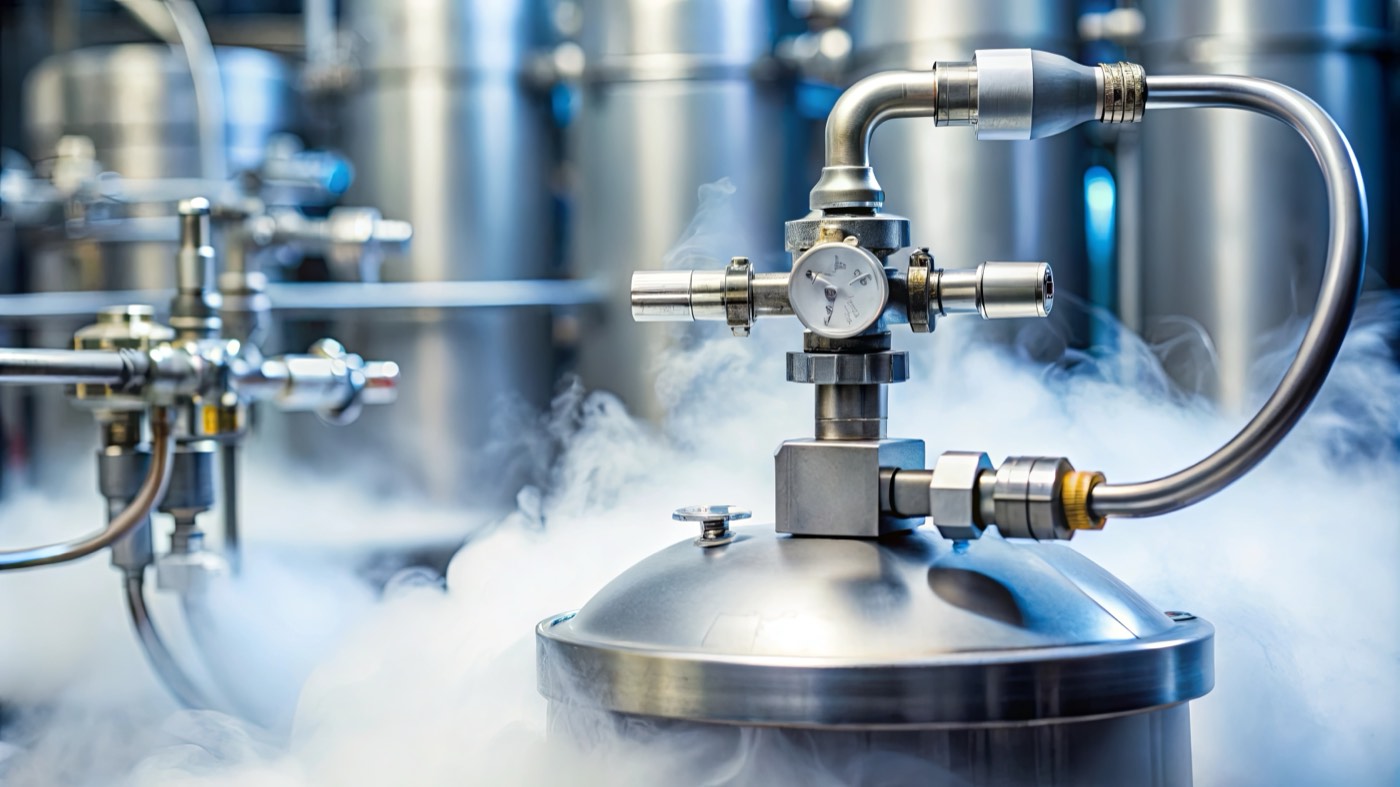
Fig. 03 / Vault feedPrimary nitrogen manifold, Sector B. Boil-off is the cooling mechanism — the vault holds temperature with every pump in the building switched off.100.000% uptime
03 Facility
Nothing in this building is allowed to depend on power.
Our Sector B vault holds patient-frame integrity on passive physics: liquid
nitrogen boils, vapor rises, temperature holds. Pumps, grids and staff are
conveniences. The hold survives all three going away.
Vault uptime since 2019
100.000%
Passive thermal reserve
14days
Independent LN₂ supply lines
3×
Thermal excursions >1 °C
0events
04 Research
Published, deposited, reproducible.
Cryosek publishes negative results. Every protocol below is deposited with
full perfusion telemetry so that any lab can attempt replication — and
several have.
Cryobiology Reports · 2025 · peer reviewed
Ice-free glass transition in whole mammalian organ models at 1.9 °C·min⁻¹
Rabbit kidney cohort (n=64). Post-rewarming perfusion recovered in 61 of 64 units with no detectable crystal fronts on cryo-SEM.
doi:10.4021/csk.2025.0114
Journal of Low-Temperature Medicine · 2024
Connectome retention under CSK-114 cryoprotectant loading
Electron-microscopy scoring of synaptic ultrastructure before and after a 400-day hold. Retention 98.2% (95% CI 97.1–99.0).
doi:10.1080/jltm.2024.8871
Preprint · 2026 · under review
Toward measurement of the patient-frame interval (the cryosec)
Framework for instrumenting subjective duration across stasis. Predicts an invariant 1.000 cs; proposes the falsification criteria that would break it.
arXiv:2602.11409
Negative result · 2023
Devitrification fracture at rewarming rates below 40 °C·min⁻¹
Published in full. Slow rewarming failed in 100% of large-volume trials. This finding set the current nanoparticle-assisted rewarming standard.
doi:10.4021/csk.2023.0402
05 Enrollment
Phase 0 is open. We are screening candidates.
Cryosek is accepting a limited observational cohort. Phase 0 involves
no induction — it is a full physiological workup, cryoprotectant tolerance
panel, and standby registration, conducted under independent IRB oversight.
Eligible — adults 18+, documented consent, no active systemic infection
Included — full workup, tolerance panel, standby registration, annual review
Cohort size — 240 candidates; 189 screened to date
Oversight — Western IRB #CSK-0114 · protocol amended 2026